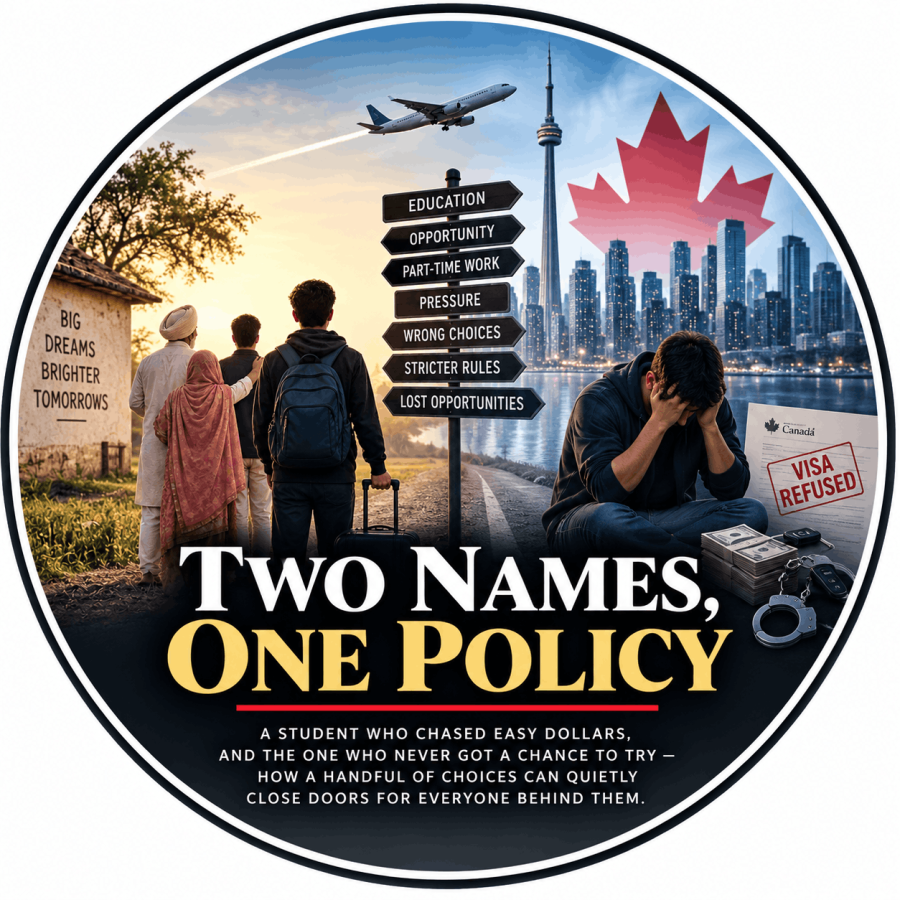
In a small house on the outskirts of a remote village in Amritsar, nineteen-year-old Jujhar Singh could barely sleep the night his visa came through. He had just finished Grade 12 in Arts, and now held in his hands an admission letter to a two-year diploma programme at Sheridan College. To his parents, it felt like a life-changing opportunity. To pay for it, they sold their farming land — the only asset they had — to cover his first year's tuition and the mandatory Guaranteed Investment Certificate. From that day on, the family's future rested on one word: Canada.
At Delhi airport, his mother held back tears as she said goodbye. Beneath the pride was a quieter, harder question she did not say aloud: When would she see her son again? Jujhar, for his part, was too excited to notice. This was not just his first flight abroad. It was his first journey of any kind beyond his hometown. He had never even boarded a train.
A New Life, Alone
The boy who had spent his years in Punjab studying, playing and living under his family's roof now had to learn independence from scratch: cooking his meals, washing his clothes, doing his laundry and working four to five hours after college simply to make ends meet.
Then came the pressure. His parents needed next year's fee. Living costs kept climbing. Slowly, the pull of easy dollars — and cash-in-hand work that kept money flowing — began to matter more than his degree. The wages were often well below what he could legally have earned, leaving him with little choice but to work longer hours to make up the difference. Classes began slipping down the priority list.
The Transformation
Within months, the transformation was visible. He bought a car on instalments and began driving recklessly — at times approaching 100 miles an hour on neighbourhood roads where the limit was 20. His circle of friends acquired a reputation of its own: parties that ran late into the night, music blaring into neighbouring homes, and lewd remarks directed at local residents.
In communities where such incidents were becoming increasingly visible, goodwill toward international students began giving way to suspicion and, in some quarters, resentment. Alongside the social friction came a harder reality: reports of carjackings and extortion that, in some communities, were increasingly being associated with individuals among the broader wave of new arrivals.
The backlash grew. Protests spread, and local residents increasingly pressed governments to rein in the rapid growth of temporary residents. Policymakers faced a difficult calculation. International students and temporary workers had become an important part of Canada's economy, yet public pressure for tighter controls was growing. Eventually, the policy direction shifted, and the brakes were applied.
The Fallout
Jujhar became one of its casualties. Buried under long work hours and increasingly distant from his studies, Jujhar failed his exams. He was placed on academic suspension and eventually sent home — back to the village, back to the land that no longer belonged to his family.
Prabhjot fared no better. As Canada's immigration rules tightened, the pathway to permanent residency he had counted on became increasingly uncertain — and eventually closed.
That distinction belongs to Navdeep — a student who, from childhood, dreamed of nothing more than a Bachelor's degree in Computer Science and Artificial Intelligence from the University of Toronto. Navdeep scored above 95% in every core subject. Navdeep earned an 8-band score in IELTS, a mark of fluency and discipline few achieve. Yet Navdeep, despite meeting the academic requirements and following the rules, was refused a visa.
A Cautionary Tale
Jujhar's story is not unique — it is one thread in a much larger pattern now playing out across immigrant communities and host nations alike. When individual choices erode collective trust, the consequences rarely remain confined to those who made them. They ripple outward, quietly closing doors for people who did everything right.